


Electronics and Telecommunications Engineering Technology
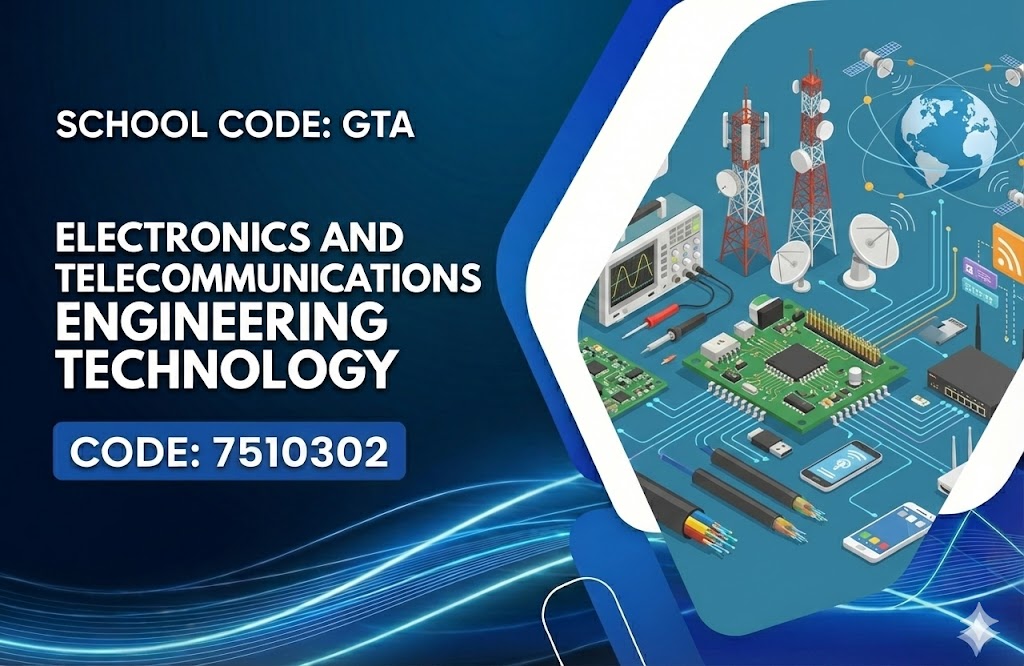
|
Major: |
Electronics and Telecommunications Engineering Technology |
|
Code: |
7510302 |
|
Specializations |
- Electronics and Telecommunications Engineering Technology - Semiconductor and Integrated Circuit Engineering Technology |
|
Training Level: |
Undergraduate |
|
Mode of Study: |
Full-time |
|
Degree Awarded: |
Engineer |
|
Training Duration: |
4.5 years |
|
Total Credits: |
160 credits |
|
Admission Requirements: |
High school graduates or equivalent who meet the minimum quality assurance threshold in accordance with the admissions regulations of the Ministry of Education and Training and the annual regular undergraduate admission plan of the University of Transport Technology. |
|
Training Language: |
Vietnamese. |
|
Year of Admission Commencement: |
2013 |
|
Year of First Graduation: |
2017 |
|
Most Recent Program Revision Year: |
2024 |
I. GENERAL INTRODUCTION
The undergraduate training program in Electronics and Telecommunications Engineering Technology is designed with an application-oriented approach, aiming to equip learners with a solid foundation of fundamental, core, and advanced knowledge in electronics, telecommunications, and semiconductor integrated circuits. Learners are provided with general education in natural sciences, social sciences, mathematics, physics, information technology, and foreign languages; foundational disciplinary knowledge such as electronic materials and components, circuit theory, programming techniques, basic electronics, and automatic control; along with systematic major and specialization courses aligned with emerging trends in electronics–telecommunications engineering and the semiconductor industry.
The program emphasizes the development of professional competencies through practical courses, laboratory work, and project-based learning, enabling learners to design, simulate, operate, and maintain electronic–telecommunication systems; analyze and process signals; design digital and analog circuits; program embedded systems; apply communication protocols, telecommunication networks, and modern communication technologies. For the semiconductor integrated circuit specialization, the program provides knowledge and skills in the processes of designing, testing, simulating, and developing ASIC/FPGA chips, VLSI systems, and integrated circuits that meet the practical demands of the semiconductor industry.
In addition to technical knowledge, the program integrates training in communication skills, teamwork, presentation skills, systems thinking, scientific research skills, and competencies in foreign languages and information technology, enabling learners to adapt and thrive in modern working environments. The program also aims to develop autonomy, a sense of responsibility, professional ethics, and lifelong learning capabilities to meet the demands of digital transformation and international integration.
After graduation, students can take on positions such as electronic circuit design engineer, embedded systems engineer, telecommunications engineer, R&D engineer, system integration engineer, or technical consultant in electronics–telecommunications companies, high-tech industries, semiconductor design firms, research centers, government agencies, or as instructors at vocational education institutions. Learners may also pursue higher education in electronics, telecommunications, semiconductor engineering, and related fields.
II. CURRICULUM STRUCTURE AND STUDY PLAN
The total volume of the entire program is 160 credits, not including Physical Education (04 credits) and National Defense and Security Education (09 credits).
Proposed Teaching and Learning Plan for a 4.5-Year Program (9 Semesters)
|
Knowledge |
Compulsory |
Elective |
Amount |
|---|---|---|---|
|
I. GENERAL EDUCATION KNOWLEDGE MODULES |
41 |
|
41 |
|
1.1. General Political Theory and Law |
13 |
0 |
13 |
|
1.2. Foreign languages |
8 |
0 |
8 |
|
1.3. Mathematics and basic sciences |
20 |
0 |
20 |
|
II. SUPPLEMENTARY KNOWLEDGE MODULES |
06 |
03 |
09 |
|
2.1. Required knowledge |
6 |
0 |
6 |
|
2.2. Elective knowledge |
0 |
3 |
3 |
|
III. PROFESSIONAL EDUCATION KNOWLEDGE MODULES |
82 |
08 |
90 |
|
3.1. Basic knowledge of the industry |
20 |
02 |
22 |
|
3.2. Industry knowledge |
28 |
0 |
28 |
|
3.3. Specialized knowledge |
34 |
06 |
40 |
|
IV. GRADUATION MODULES |
20 |
0 |
20 |
|
4.1. Graduate Internship |
12 |
0 |
12 |
|
4.2. Thesis/Graduation Project |
08 |
0 |
08 |
|
Total |
149 |
11 |
160 |


