


Developing the University of Transport Technology into a Leading Centre for Applied Technology in Vietnam
The Development Strategy to 2035, with a Vision to 2045, sets out a new direction for the University of Transport Technology, aiming to establish the University as a reputable centre for education, applied research and technology transfer in Asia.
Positioning UTT as a Key University of Applied Technology
The Ministry of Construction has recently approved the Development Strategy of the University of Transport Technology (UTT) to 2035, with a Vision to 2045, identifying modern railways, intelligent transportation and advanced infrastructure as the University's foremost strategic priorities.
The objective is to develop UTT into a key higher education institution specialising in applied technology under the Ministry, playing a central role in human resource development, research and technology transfer to support the development of the construction sector.
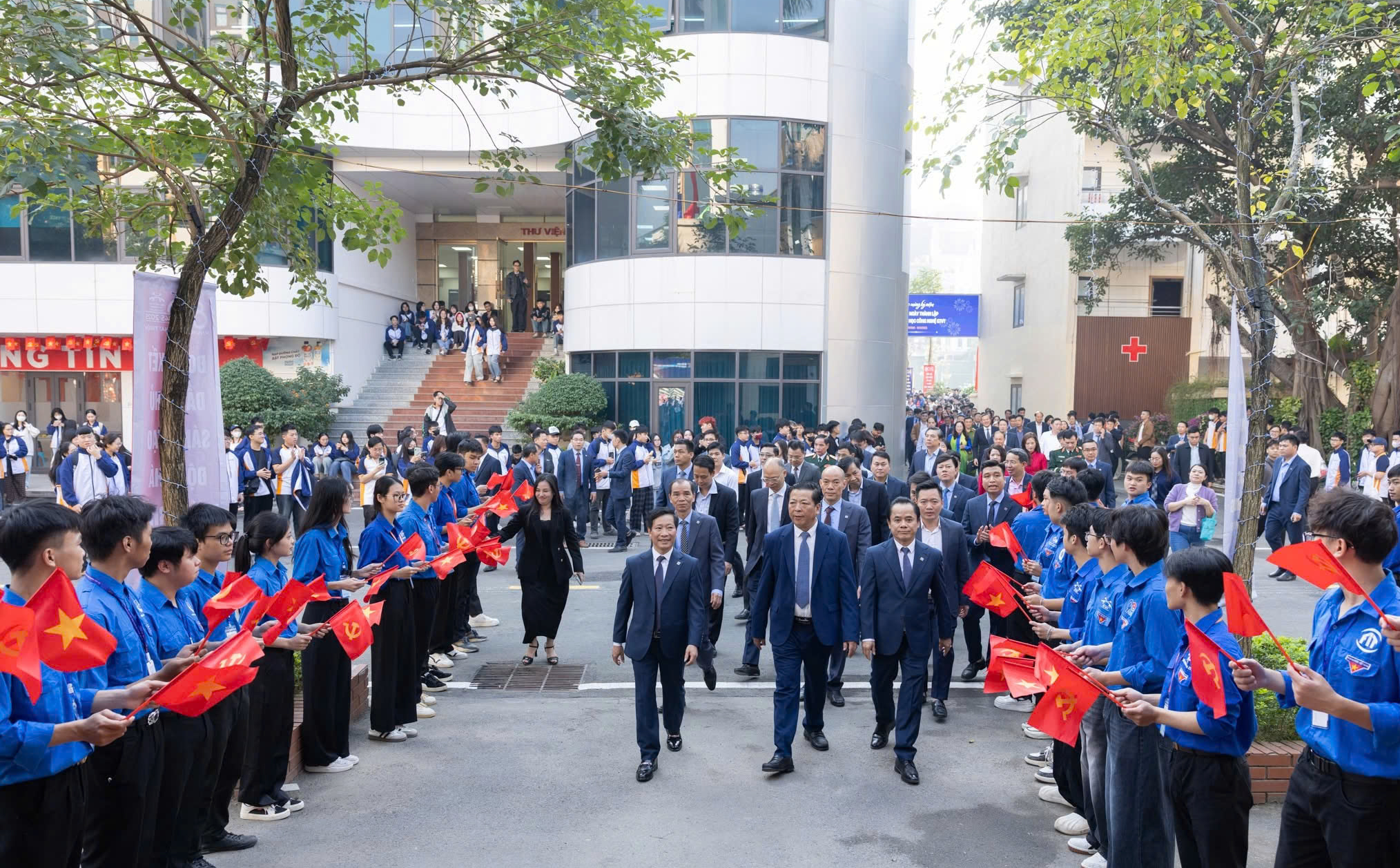
Minister of Construction Tran Hong Minh attending a commemorative event at the University of Transport Technology.
According to Decision No. 1868/QD-BXD, signed and issued by Minister of Construction Tran Hong Minh on 29 October 2026, the University of Transport Technology is to be developed into one of Vietnam's leading and most reputable applied technology universities in the fields of railways, advanced infrastructure and intelligent transportation.
The strategy focuses on strengthening the University's capabilities in education, applied research and technology transfer in fields of strategic importance to the construction sector. Educational quality, innovation and applied research are identified as the pillars of development, closely aligned with workforce requirements, the sector's practical needs and business activities.
The University also aims to develop according to a modern, autonomous and internationally integrated university model, reforming its governance through data-driven approaches, streamlining its organisational structure and improving resource efficiency.
Guided by the educational philosophy of “Application – Practical Learning – Career Readiness”, the University seeks to train highly qualified human resources capable of adapting to practical requirements while promoting research, innovation and technology transfer in transport, construction and infrastructure development.
Under the development roadmap, by 2030, the University will focus on consolidating its foundations in governance, human resources, academic programmes, science and technology, facilities and digital infrastructure. It will also gradually develop its capabilities in railway education, applied research and technology transfer.
By 2035, the objective is to consolidate strategic capabilities and establish a relatively comprehensive ecosystem encompassing education, research, innovation, testing and technology transfer in its priority fields.
With a vision to 2045, the University aspires to become a reputable applied technology university in Asia and an important centre for education, research and technology transfer, contributing significantly to the construction sector and national development.
One of the strategy's highlights is the implementation of five breakthrough programmes, covering modern railway development; intelligent transportation; advanced and sustainable infrastructure; smart university development; and quality enhancement and international integration.
Among these, modern railway development is identified as the University's foremost strategic priority, intended to establish specialised capabilities and distinctive competitive advantages.
The objective is to develop the University of Transport Technology into a reputable, key educational institution in the sector, specialising in human resource development, applied research, innovation and technology transfer to support the development of high-speed railways, electrified railways and urban railway systems.
To achieve this objective, the University will simultaneously strengthen its educational capabilities, develop expert teams and specialised research groups, and invest in laboratories, research infrastructure, simulation facilities and testing systems. It will also expand cooperation with government authorities, enterprises and international partners to enhance its capacity to acquire, adapt, integrate and localise modern railway technologies, gradually achieving technological mastery.
Notably, by 2035, the University will prioritise the establishment and development of a School of Railway Technology under the University of Transport Technology, adopting an application-oriented approach aligned with international standards.
The School is expected to become a core academic and technological institution capable of directly participating in national railway programmes and projects, supporting the development of the railway industry and the localisation of technology. It will thereby contribute to building human resources and strengthening research and technology transfer capabilities for major railway projects.
Alongside railway development, intelligent transportation is identified as another strategic field in which the University aims to establish distinctive capabilities.
The focus will be on developing interdisciplinary education integrating transport, infrastructure and digital technologies, while promoting research, integration, simulation, testing and the transfer of emerging technologies.
Priority areas include artificial intelligence (AI), the Internet of Things (IoT), Building Information Modelling (BIM), Digital Twin technology, Intelligent Transportation Systems (ITS), data analytics and transport system simulation. These technologies are intended to support the management, operation and monitoring of transport systems while improving their operational efficiency.
By 2035, the University aims to establish a relatively comprehensive system of capabilities in intelligent transportation education, research, data, digital modelling, simulation, testing and technology transfer, gradually bringing models, tools and solutions into practical application.
In the field of advanced and sustainable infrastructure, the strategy focuses on developing capabilities in education, research, testing, inspection and technology transfer for the construction and management of transport infrastructure.
Key research areas include digitalisation and automation in infrastructure design, construction and management; the development of advanced materials, low-carbon materials and circular economy solutions; and the application of structural health monitoring technologies, asset management and predictive maintenance.
By 2035, the University aims to become one of Vietnam's leading centres in testing, inspection, structural health monitoring, and the management and maintenance of transport infrastructure.
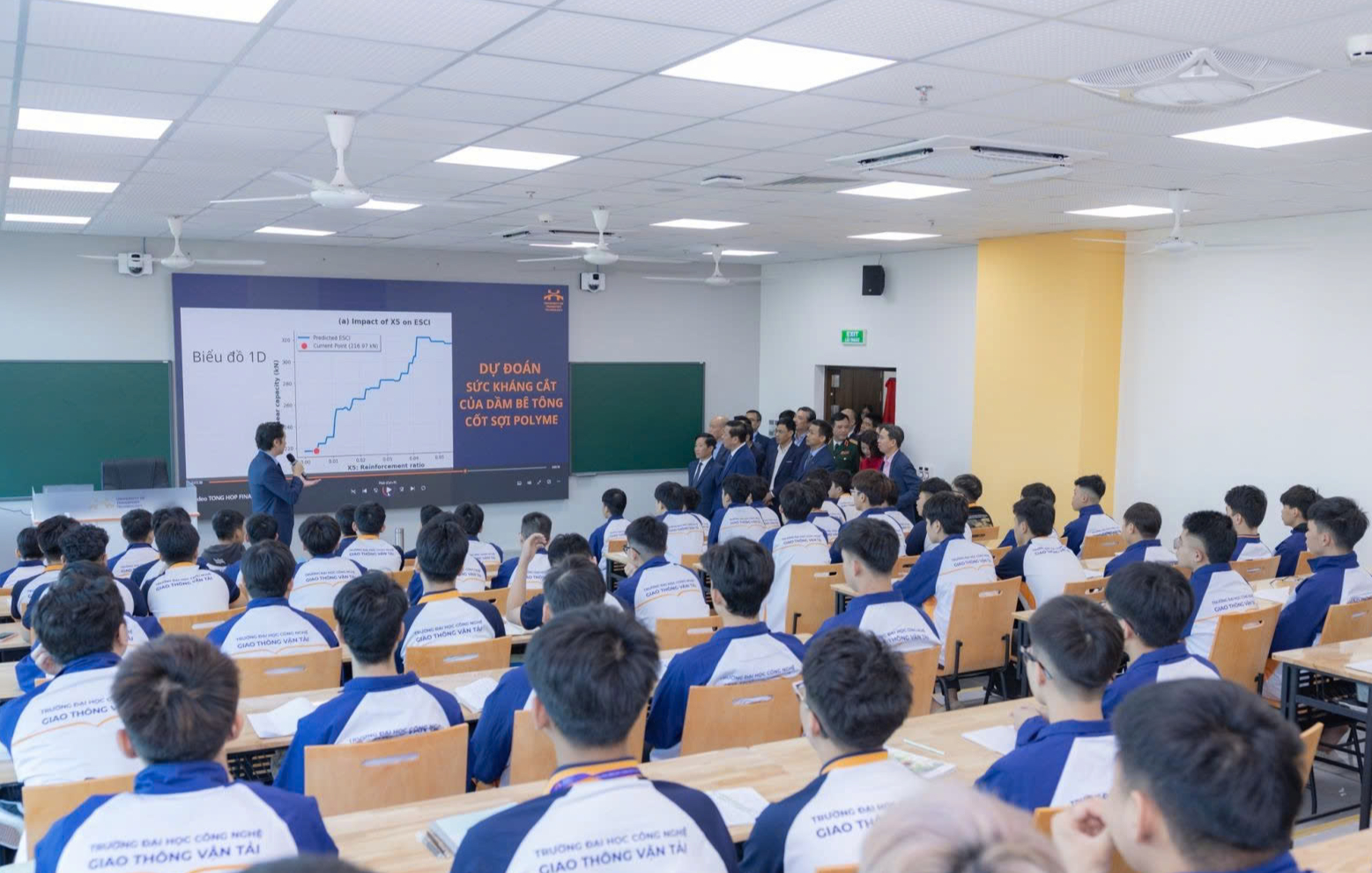
The University of Transport Technology has attracted students to its academic programmes in recent years.
Building a Smart University and Strengthening International Integration
The remaining two breakthrough programmes focus on developing a smart university model and enhancing educational quality and international integration.
Accordingly, data and digital technologies will become the foundation for reforming university governance, education, research and student services. The University will gradually transition from the digitalisation of individual activities towards data-driven governance and operations, with integrated systems supporting connectivity and decision-making.
By 2035, the University aims to operate a relatively comprehensive smart university model, with key governance processes standardised and interconnected, integrated data effectively utilised for management and administration, and educational, research and student support activities connected through a digital environment.
Regarding quality and international integration, the University aims to develop a substantive quality assurance system based on data and continuous improvement, while gradually introducing academic programmes that meet international standards.
At the same time, the University will promote the internationalisation of its academic staff, students and research activities; expand its network of strategic partners; improve the quality of scientific publications; and strengthen its capacity to participate in reputable international university ranking systems.
To implement the five breakthrough programmes, the Ministry of Construction has identified key groups of solutions relating to organisational structure, governance, facilities, education, human resources, finance, and science and technology.
In terms of organisation, the University will continue reforming its governance model towards a streamlined, autonomous and digitalised structure with greater accountability, linking decentralisation with effective performance monitoring.
Regarding facilities, investment will be prioritised for infrastructure supporting the breakthrough programmes, including laboratories, research centres, simulation and testing facilities, and learning spaces. University campuses will be developed towards green, smart and low-emission models.
Notably, the University will organise its operations according to a multi-campus model, promoting complementary functions among its educational locations.
During the 2026–2030 period, the University will focus on restructuring its existing campuses, accelerating the completion and commissioning of projects with approved investment policies in Thanh Liet, and completing the necessary procedures for site clearance and construction investment at the Binh Minh Campus in Hanoi when conditions permit. It will also continue finalising plans to expand its campus in Vinh Yen Ward, Phu Tho Province, and renovate and upgrade its Thai Nguyen Campus.
In education and training, the University will restructure its academic disciplines and programmes around priority fields, focusing on education, professional development and skills conversion to meet workforce requirements for railway projects, advanced infrastructure and intelligent transportation. Educational activities will be closely connected with practical training, enterprises and real-world projects, with particular attention given to postgraduate education, retraining and workforce development.
In parallel, the University will focus on attracting and developing lecturers, scientists, leading experts and strong research groups. It will implement policies to attract and retain talented individuals, linking performance evaluation to measurable outcomes.
Regarding finance, the University aims to diversify its revenue sources and improve the effectiveness of financial autonomy. It will increase income from science and technology activities, innovation, technology transfer, consultancy and business partnerships. At the same time, it will mobilise Official Development Assistance (ODA), grants, sponsorships and other lawful resources for investment and development activities.
Science and technology activities will focus on applied research, technological development, testing and technology transfer. Research tasks will be aligned with the requirements of the Ministry of Construction and infrastructure projects, while promoting the commercialisation of research outcomes and the development of intellectual property.
Resources for implementing the strategy will be mobilised from the University's lawful revenues, state budget allocations for approved tasks, public investment capital, ODA, grants, sponsorships, business partnerships and other lawful sources.
The implementation roadmap is divided into two phases. The 2026–2030 phase will prioritise establishing foundational capabilities, developing the railway sector, strengthening academic staff, improving academic programmes, and investing in laboratories and digital infrastructure. The 2031–2035 phase will focus on more intensive investment, expanding research, testing and technology transfer, strengthening international integration and developing campuses in accordance with approved plans.
The Ministry of Construction has assigned the University of Transport Technology to take the lead in implementing the strategy, developing annual and phased plans, and specifying targets, tasks, schedules, deliverables, resources and performance indicators.
The University is responsible for conducting periodic assessments, submitting annual reports to the Ministry of Construction and organising phase-based evaluations in 2030 and 2035. Agencies and units under the Ministry will coordinate, provide support and give priority consideration, in accordance with regulations, to assigning tasks and commissioning education, scientific research, innovation and technology transfer activities in the priority fields.
With modern railways, intelligent transportation and advanced infrastructure as its central priorities, the Development Strategy to 2035, with a Vision to 2045, lays the foundation for the University of Transport Technology to enhance its educational and research capabilities, achieve greater technological mastery and contribute to preparing highly qualified human resources for Vietnam's strategic infrastructure projects.
Source: Construction Newspaper


