


Three UTT Scientists Ranked Among the Most Influential Researchers Worldwide: A Milestone in Research Investment at UTT
Three scientists from the University of Transport Technology (UTT) have once again been included among the world's top 100,000 scientists in terms of citation impact in 2026, with one ranking among the global Top 10,000. This achievement highlights the research capabilities of the University's academic staff and reflects its strategic direction in science and technology development, building on its strengths in transport, construction, artificial intelligence and digital transformation.
Three Scientists, Three Research Directions with Practical Value
According to the database developed by a research team at Stanford University (USA) and published by Elsevier in 2026, based on Scopus data through the end of 2025, UTT has three scientists ranked among the world's top 100,000 researchers in terms of citation impact. Notably, Assoc. Prof. Dr. Pham Thai Binh ranks 5,427th globally, making him one of nine Vietnamese scientists in the world's Top 10,000.
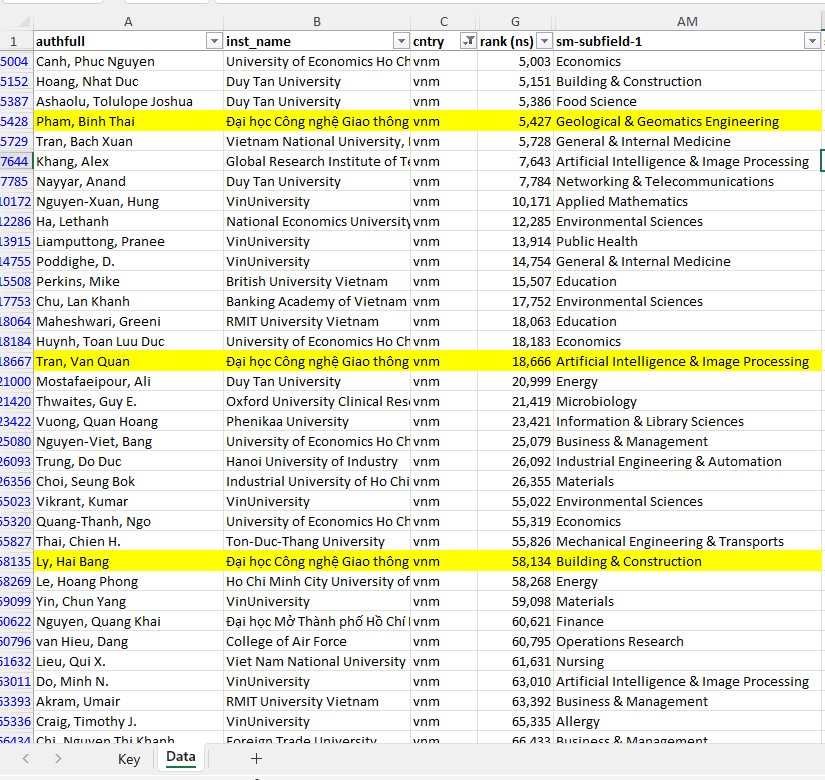
Data on scientists and their rankings published by Elsevier–Stanford in October 2026.
Assoc. Prof. Dr. Pham Thai Binh, Editor-in-Chief of the Journal of Science and Transport Technology (JSTT), specialises in geological engineering, geospatial engineering, geotechnical engineering and the application of artificial intelligence in analysing and predicting soil characteristics, landslide risks and structural stability. Based on citation impact indicators for 2025, he ranks among the world's top 0.058% in the field of Geological and Geomatics Engineering. These research areas have significant practical implications for the investigation, design and safety assurance of transport infrastructure.
Assoc. Prof. Dr. Tran Van Quan, Deputy Director of the Institute of International Education and Cooperation and Deputy Editor-in-Chief of the Journal of Science and Transport Technology, ranks 18,666th globally, rising 9,346 places compared with the previous ranking. His research integrates artificial intelligence, data science, construction materials and structural durability. Based on annual citation impact assessments, he ranks among the world's top 0.186% in Artificial Intelligence and Image Processing. His research focuses on improving predictions of infrastructure service life, assessing material deterioration and supporting the safety management of infrastructure structures.
Assoc. Prof. Dr. Ly Hai Bang ranks 58,134th globally, climbing 15,758 places compared with the previous year and placing among the world's top 0.912% in the field of Civil Engineering according to the annual assessment. As Deputy Director of the Institute of Railway and Transport Technology and Director of the BIM & AI Technology Centre, his research focuses on Building Information Modelling (BIM), artificial intelligence and digital technology solutions for infrastructure design, construction, operation and management.
A notable common feature of the three scientists is their integration of traditional engineering disciplines with modern technologies. From geotechnical engineering, construction materials and structural engineering to artificial intelligence, big data and BIM, their research directions all have the potential to be developed into practical solutions for the transport and construction sectors.
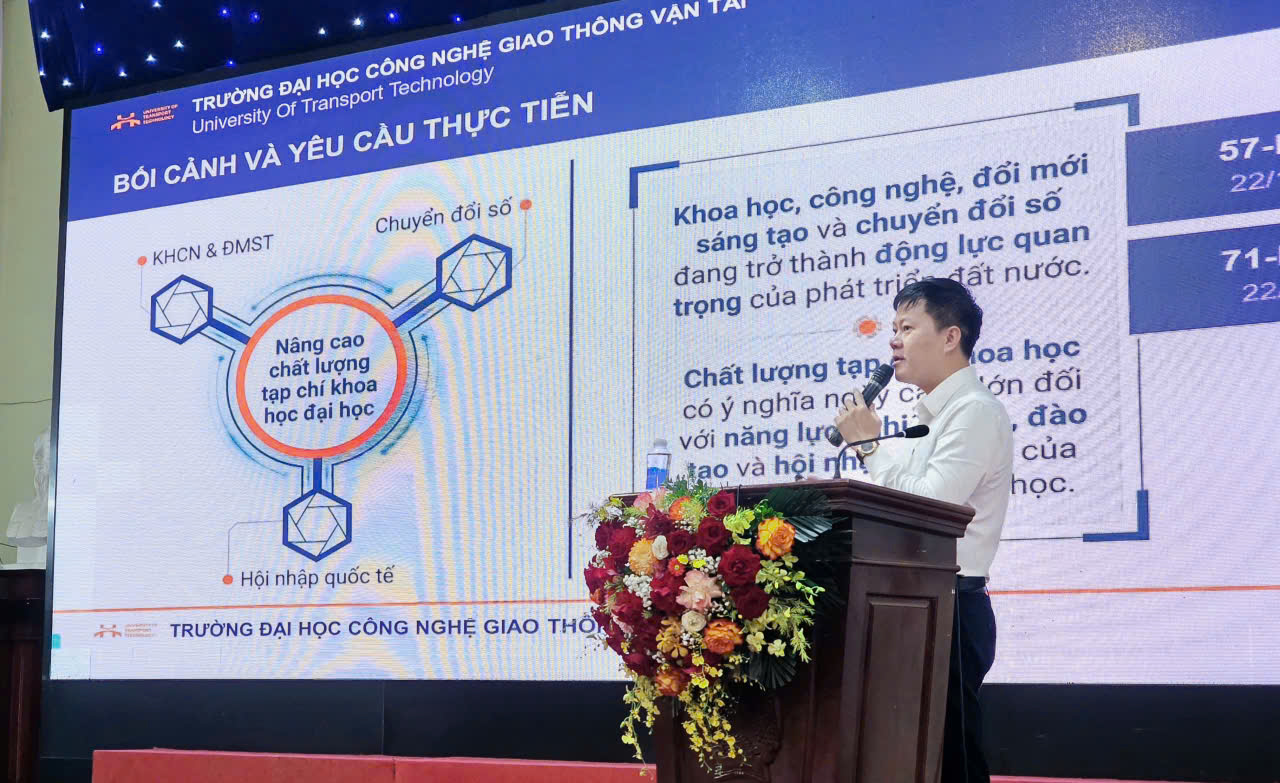
Assoc. Prof. Dr. Pham Thai Binh presenting a report at the Conference on Implementing the Press Law and Enhancing the Quality of Vietnamese Scientific Journals
Behind the Scientists' Success: UTT's Development Strategy
The achievements of these scientists are closely linked to the University's research environment and development strategy. In recent years, UTT has focused on developing strong research groups, investing in facilities and specialised laboratories, promoting international cooperation and strengthening connections with enterprises. The University has gradually developed an interdisciplinary research ecosystem, linking scientific activities with high-quality human resource development and the practical needs of the transport and construction sectors.
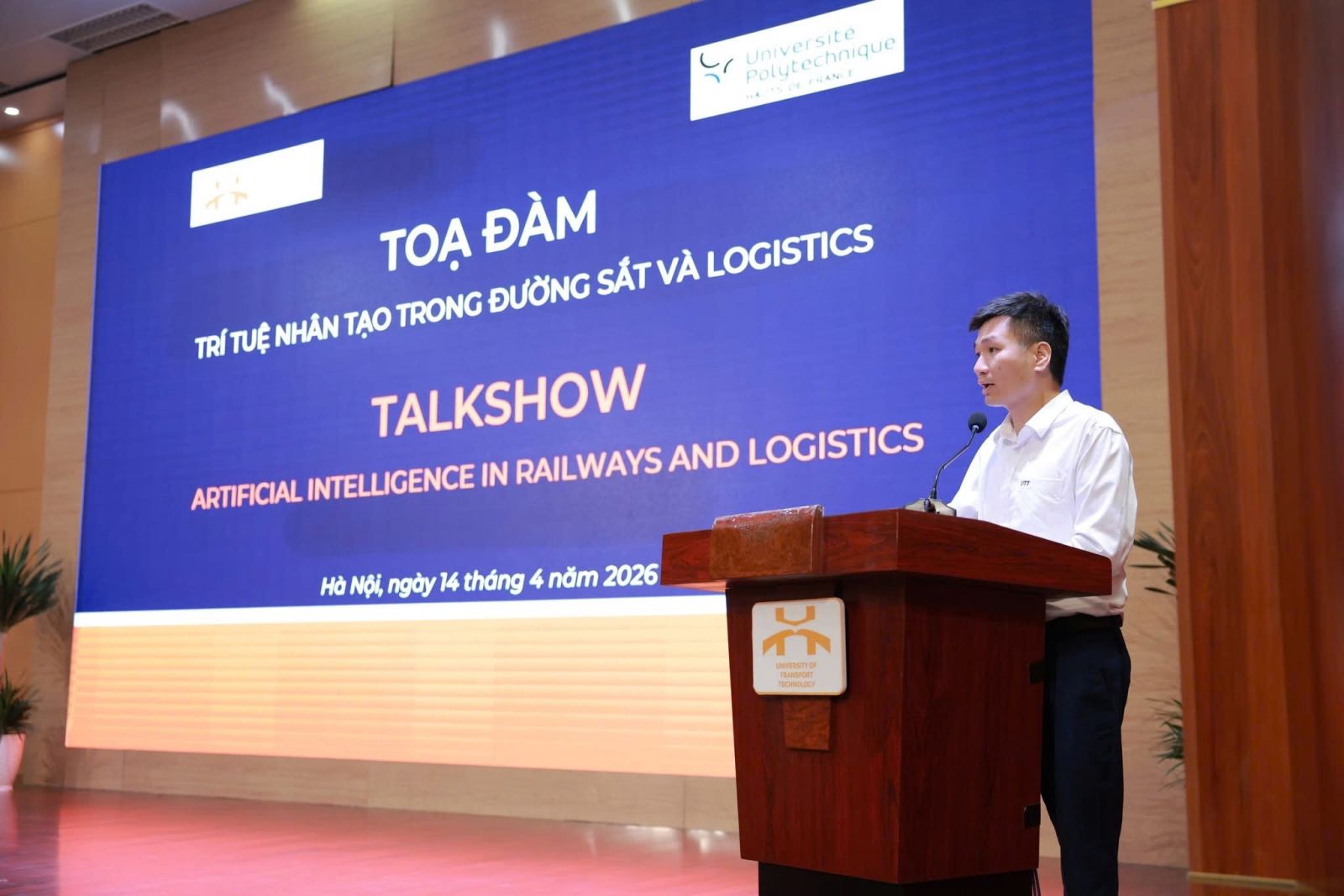
Assoc. Prof. Dr. Tran Van Quan sharing insights at a talk show on Artificial Intelligence in Railways and Logistics
Laboratories and research centres specialising in intelligent transport, BIM and artificial intelligence, together with collaborative networks involving domestic and international scientists, provide opportunities for lecturers, PhD students and undergraduate students to participate in addressing scientific challenges with practical applications.
Within this strategic direction, international publications serve as an important measure of research quality and impact, but they are not the ultimate goal. Building on research outcomes recognised by the international scientific community, UTT aims to develop technologies, engineering solutions, applied products and technology transfer activities for enterprises.
This approach is also consistent with the characteristics of a technology-oriented university, where research activities must simultaneously generate new knowledge, train scientific personnel and address practical challenges.
From International Publications to an Innovation Ecosystem
Alongside the achievements of its scientists, the inclusion of the Journal of Science and Transport Technology (JSTT) in the Scopus database marks an important milestone in UTT's international academic integration. This achievement contributes to enhancing the University's academic standing, expanding opportunities for knowledge exchange, research collaboration and the publication of scientific findings in transport, construction and technology.
At the applied research level, UTT is focusing on areas where it has competitive strengths, including intelligent transport technologies, artificial intelligence, BIM, construction materials and structures, and digital transformation in infrastructure management. Being assigned to lead the network of centres of excellence and talent development in advanced and intelligent transport technology and infrastructure further creates opportunities to connect scientific research with high-tech human resource development.
In particular, the University's strategic direction in railway technology education and research, including cooperation among Hanoi, the French Development Agency (AFD) and UTT, introduces new requirements for research, technology acquisition and human resource development for strategic infrastructure projects. These initiatives demonstrate how UTT is gradually connecting three key pillars: scientific research, high-quality human resource development and the practical application of technology.
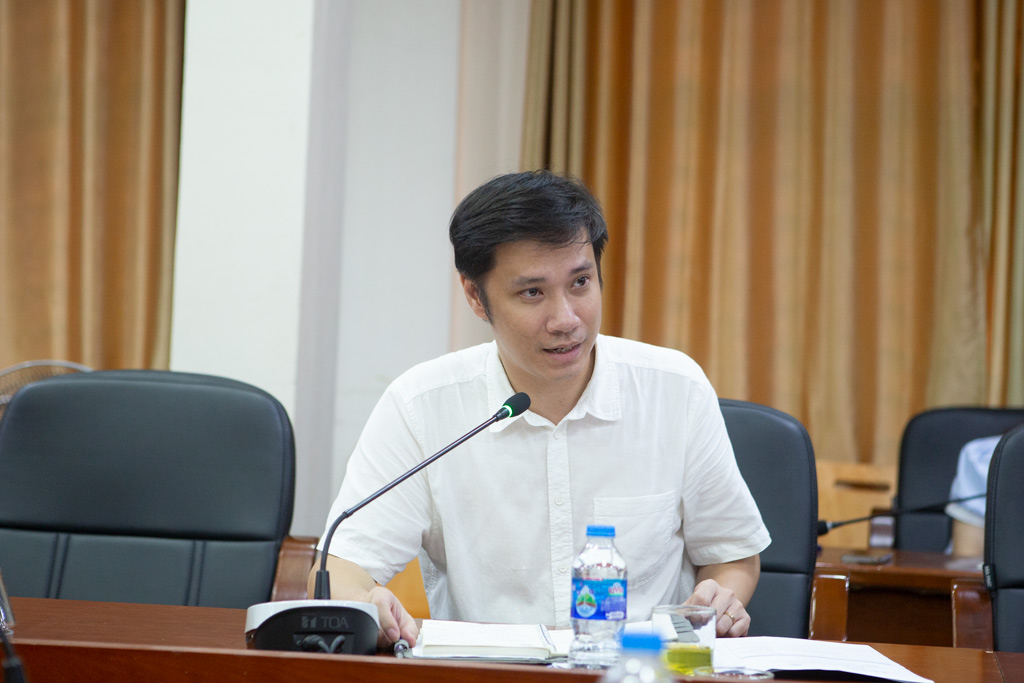
Assoc. Prof. Dr. Ly Hai Bang sharing insights at a seminar on Artificial Intelligence
Maintaining the Strategic Direction Set by Resolutions No. 57 and No. 71
Resolution No. 57-NQ/TW of the Politburo on breakthroughs in science, technology, innovation and national digital transformation, together with Resolution No. 71-NQ/TW on breakthroughs in education and training development, emphasises the need to enhance research capacity, develop high-quality human resources and strengthen cooperation among universities, research institutes and enterprises.
For UTT, developing strong research groups, promoting international publications, expanding cooperation with leading scientists and investing in specialised laboratories are concrete steps towards implementing these strategic directions. More importantly, the University recognises the need to further integrate research outcomes into education in Science, Technology, Engineering and Mathematics (STEM), while developing technological products with potential for practical application, transfer and commercialisation.
The recognition of three UTT scientists in the 2026 international citation impact database is a source of pride, but it also highlights the need to continue improving research quality and technological capabilities. The sustainable value of a university lies not only in the number of publications or the rankings of its scientists, but also in its ability to transform knowledge into technologies, products and human resources that contribute to national development.
Building on its achievements and ongoing strategic initiatives, UTT is gradually affirming its commitment to in-depth science and technology development, international integration and alignment with the practical needs of the transport and construction sectors in the new development period.
University of Transport Technology


