


Transport Operations
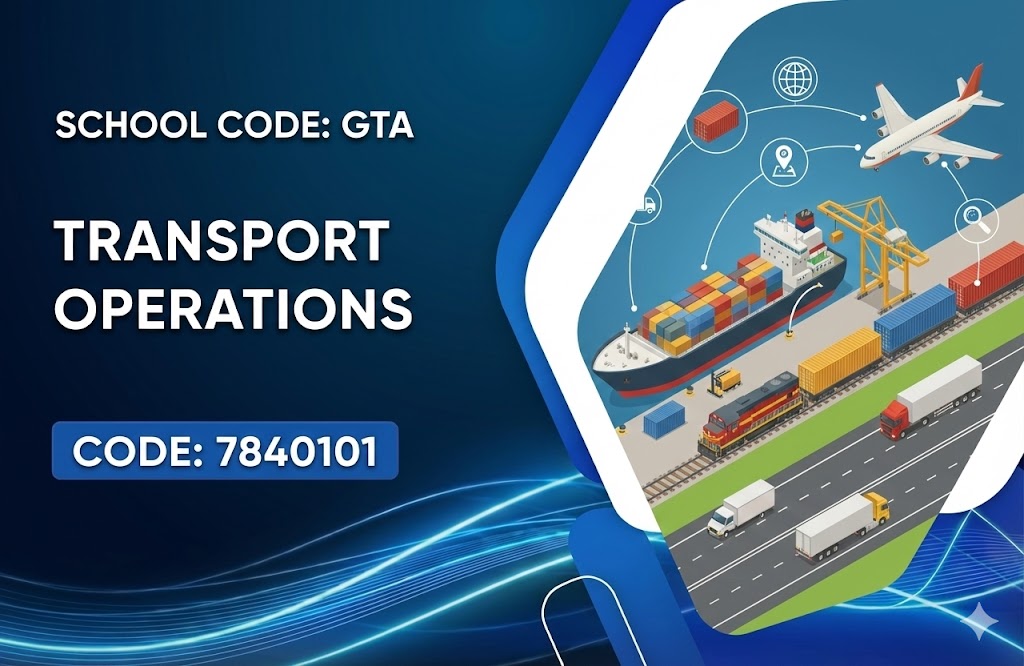
|
Major: |
Transport Operations |
|
Code: |
7840101 |
|
Specializations |
- Logistics and Multimodal Transport - Railway Transport Management and Operations |
|
Training Level: |
Undergraduate |
|
Mode of Study: |
Full-time |
|
Degree Awarded: |
Bachelor |
|
Training Duration: |
4 years |
|
Total Credits: |
135 credits |
|
Admission Requirements: |
High school graduates or equivalent who meet the minimum quality assurance threshold in accordance with the admissions regulations of the Ministry of Education and Training and the annual regular undergraduate admission plan of the University of Transport Technology. |
|
Training Language: |
Vietnamese. |
| Year of Admission Commencement |
2014 |
| Year of First Graduation |
2019 |
| Most Recent Program Revision Year |
2024 |
I. GENERAL INTRODUCTION
The undergraduate program in Transport Operations is developed with an application-oriented approach, aiming to train graduates with professional knowledge and practical skills that meet the demands of the transportation and logistics sector in the context of international integration and digital transformation. The program equips learners with a solid foundation in mathematics, basic sciences, and information technology, together with fundamental and specialized knowledge in transport system operations and management, transport infrastructure utilization, route and traffic flow management, transport vehicle operations, transport planning and control, logistics and supply chain management, transport economics, as well as legal and state management frameworks in the field of transportation.
In addition to specialized knowledge, the program emphasizes the development of essential professional skills, including the planning and organization of transport operations; management and control of transport and logistics activities; analysis and evaluation of transport system and vehicle utilization efficiency; application of information technology, intelligent transport systems, and industry-specific software in transport operation and management; independent and teamwork skills; communication and negotiation skills; systems thinking; and the effective use of foreign languages and digital technologies in professional practice. Learners are also trained to develop a professional working style, responsibility, professional ethics, self-learning capacity, and innovative thinking to meet the requirements of digital transformation and the Fourth Industrial Revolution.
Upon graduation, graduates of the Transport Operations program may undertake positions such as transport operations officers and managers at road, railway, inland waterway, and air transport enterprises; logistics and supply chain specialists; staff at traffic control and operation centers, ports, terminals, and stations; specialists at state management agencies in the field of transportation; or positions at research institutes and educational institutions related to transport and logistics. Graduates are also well prepared to pursue postgraduate studies in related fields.
II. CURRICULUM STRUCTURE AND STUDY PLAN
The total volume of the entire program is 135 credits, not including Physical Education (04 credits) and National Defense and Security Education (09 credits).
Proposed Teaching and Learning Plan for a 4-Year Program (8 Semesters)
|
Knowledge |
Required |
Elective |
Total |
|---|---|---|---|
|
I. GENERAL EDUCATION KNOWLEDGE MODULES |
33 |
|
33 |
|
1.1. General Political Theory and Law |
13 |
|
13 |
|
1.2 Physical Education |
2 |
2 |
4 |
|
1.3 National Defense and Security Education |
9 |
|
9 |
|
1.4. Foreign languages |
8 |
|
8 |
|
1.5. Basic mathematics and science |
12 |
|
12 |
|
II. SUPPLEMENTARY KNOWLEDGE MODULES |
6 |
3 |
9 |
|
III. PROFESSIONAL EDUCATION KNOWLEDGE MODULES |
71 |
6 |
77 |
|
3.1. Basic industry knowledge |
23 |
|
23 |
|
3.2. Industry knowledge |
16 |
|
16 |
|
3.3. Specialized knowledge |
32 |
6 |
38 |
|
IV. GRADUATION MODULES |
16 |
|
16 |
|
4.1. Graduation internship |
8 |
|
8 |
|
4.2. Graduation thesis |
8 |
|
8 |
|
Total |
126 |
9 |
135 |


